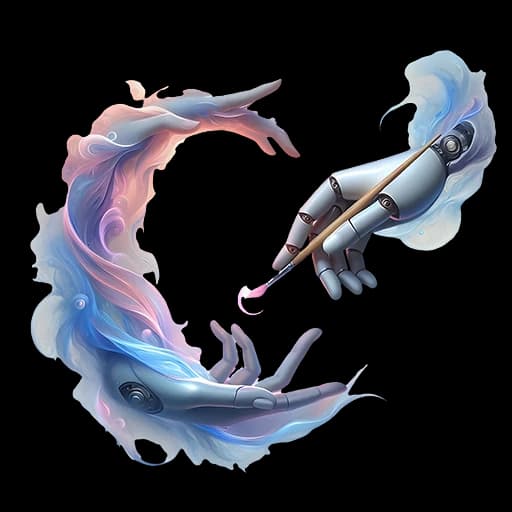
AI-Generated Art Isn't Coming For Your Practice. It's Coming For Your Excuse.

Coartist Team

AI-Generated Art Isn't Coming For Your Practice. It's Coming For Your Excuse.
A lot of artists are scared AI is going to make their skills worthless. They're looking at the wrong threat.
This is not going to be a defensive hot take about how "real art" requires human hands or how AI will never have a soul. It's going to be a clear-eyed look at what's actually changing and what it means for your development as an artist.
The honest answer is nuanced. Some things AI changes significantly. Some things it doesn't change at all. And one thing it has changed in a way almost nobody is talking about.
What AI Actually Threatens (And What It Doesn't)
Let's start with what AI image generation does well. It produces outputs that are visually impressive on first glance, stylistically consistent when prompted carefully, and practically infinite in volume. For certain commercial applications, like generating placeholder assets, concept thumbnails, and mood board images, it can replace hours of human work. That's real and it's not going away.
What it doesn't do is understand why the image works.
This sounds like a philosophical distinction. It's actually extremely practical.
When you commission or generate an AI image of a character in dramatic lighting, the image is produced without anyone understanding the light source, the bounce light behavior, the color temperature shift, the edge treatment in deep shadow, or why any of those things create the mood they create. The output exists. The understanding doesn't.
Now imagine you're in a creative direction role, or you're refining an AI output, or you're collaborating with another artist, or you're trying to push an image further than the first pass. All of those things require understanding, not just output. The gap between "I can generate a cool image" and "I understand why it works visually" is not closing. It's getting wider.
Artists who understand principles are increasingly valuable for exactly this reason. They can evaluate AI outputs, direct them purposefully, refine what doesn't work, and push past the median. Artists who relied on reference-copying and technical shortcuts, without understanding why things work, are in a harder position.
The Excuse That's Going Away
Here's the thing that is changing though, and it matters for your practice.
The old excuse for not developing fundamentals was largely economic and access-based: quality references are expensive, good tutorials are behind paywalls, formal training costs money, decent software has steep subscription costs.
AI tools have removed most of those friction points. Reference images for any subject? Generated in seconds for free. Explanations of technique? AI assistants can walk you through principles in plain language, immediately, for free. Software? The barrier to entry for digital art has never been lower.
This means the remaining obstacles to improving are almost entirely personal: time, consistency, deliberate practice, and willingness to be bad at something long enough to get better at it. The external excuses are substantially gone.
That's a gift to serious learners. And it's a gap-widener for everyone else.
The Comparison Trap Gets Worse, Then Better
One thing AI has genuinely made harder for developing artists is the comparison trap.
When your inspiration feed contains both human artists your skill level and AI-generated content that technically outperforms professional illustrators, the signal is completely broken. You're comparing your in-progress learning work to outputs that aren't produced by a learner at all. That comparison is meaningless, but it doesn't feel meaningless when you're in the middle of it.
The useful reframe is this: AI outputs are not the benchmark for your development. They're a different category of thing entirely, like asking why your nature photography doesn't look like a rendered 3D scene. They don't occupy the same evaluative space.
Your benchmark is your own past work. The question is not "can I draw better than an AI generator." The question is "can I draw better than I could three months ago." That metric is immune to the AI comparison problem because it's about your trajectory, not your absolute position relative to tools that operate by completely different means.
What Changes in Your Practice (Practically Speaking)
A few things shift if you take the AI landscape seriously.
Speed of reference matters less. Gathering reference used to take time. That time now rounds to zero. What this means for your practice is that there's no longer an excuse for not having reference during sessions. Use it more. Study it more deliberately. The availability is not the barrier anymore.
Understanding principles becomes more valuable. If AI can generate technically competent outputs without understanding, then the differentiator for human artists is understanding. Study the why, not just the how. Learn to articulate why a composition works, why a lighting setup creates the mood it creates, why specific color choices create harmony or tension. That understanding is what you bring that the generator doesn't.
Feedback loops accelerate. AI critique tools can give you immediate, structured feedback on your work between sessions with human mentors or community critique cycles. Used well, this means more iterations in less time. More feedback loops means faster improvement.
The Right Relationship with AI Art Tools
The position that makes the most sense for a developing artist is pragmatic: use AI tools where they genuinely serve your learning, be clear-eyed about what they can't teach you, and don't let the spectacular outputs of AI generators become your reference point for self-evaluation.
AI critique tools, for example, are genuinely useful when used as a mid-practice diagnostic rather than a final judgment. Getting specific structural feedback on your work before finishing it tells you what to address in the session, not just what to feel bad about after.
That's AI as a practice tool: feedback that feeds action. That's meaningfully different from AI as output generator: convenience that shortcuts understanding.
Today's action: Look at a piece you're currently working on and ask yourself: do I understand why the choices I'm making work? Can you articulate the light logic, the compositional intention, the color rationale? If some of those answers are fuzzy, that's your next study target. No AI generator can close that gap for you.
Coartist's AI critique tool is built around the practice-tool model: specific, actionable feedback that tells you what to work on next, not just whether the piece "looks good."
Coartist Team
The Coartist Team is dedicated to helping artists improve their craft through AI-powered feedback and smart practice tools.
Related Articles
The Future of AI in Art Education: Trends and Predictions
AI is revolutionizing how we learn and create art. Discover the emerging trends and predictions for AI's role in art education.
Read article
How to Get Better Critique From AI Without Changing Your Style
AI feedback gets powerful when you control the inputs. Use this checklist to get clearer critique, keep your style intact, and iterate with confidence.
Read article
AI Critique Ethics and Privacy: What Artists Should Know Before Uploading Work
Before you upload art for AI feedback, understand what happens to the file. Use this checklist to protect your work and avoid avoidable risks.
Read article